Showing posts with label Orchestrion. Show all posts

Wednesday, May 30, 2018


                                     MAKING AN ORCHESTRION                                                     PART 8


 As we told you in Part 7, we put the top shelf back in the piano and after getting the test roll in place, discovered a time consuming result of POOR PLANNING.   

We connected the tracker bar, but without considering that the roll drive works from the back side of the paper.   Thus we have the whole tracker bar tubing reversed side to side.   This means that we have to take the shelf out and retube the whole tracker bar.   Not a technically difficult job, but time consuming and very embarrassing.  

Wednesday, May 16, 2018


                                              MAKING AN ORCHESTRION                                         PART 7


The piano we chose for this project is a 1909 Weber.   We have put the top shelf back in the piano and are about to test the piano playing part.


I got the test roll and discovered that the tube it is mounted on is undersized.   I unrolled it, made a correct sized tube and remounted the test roll.


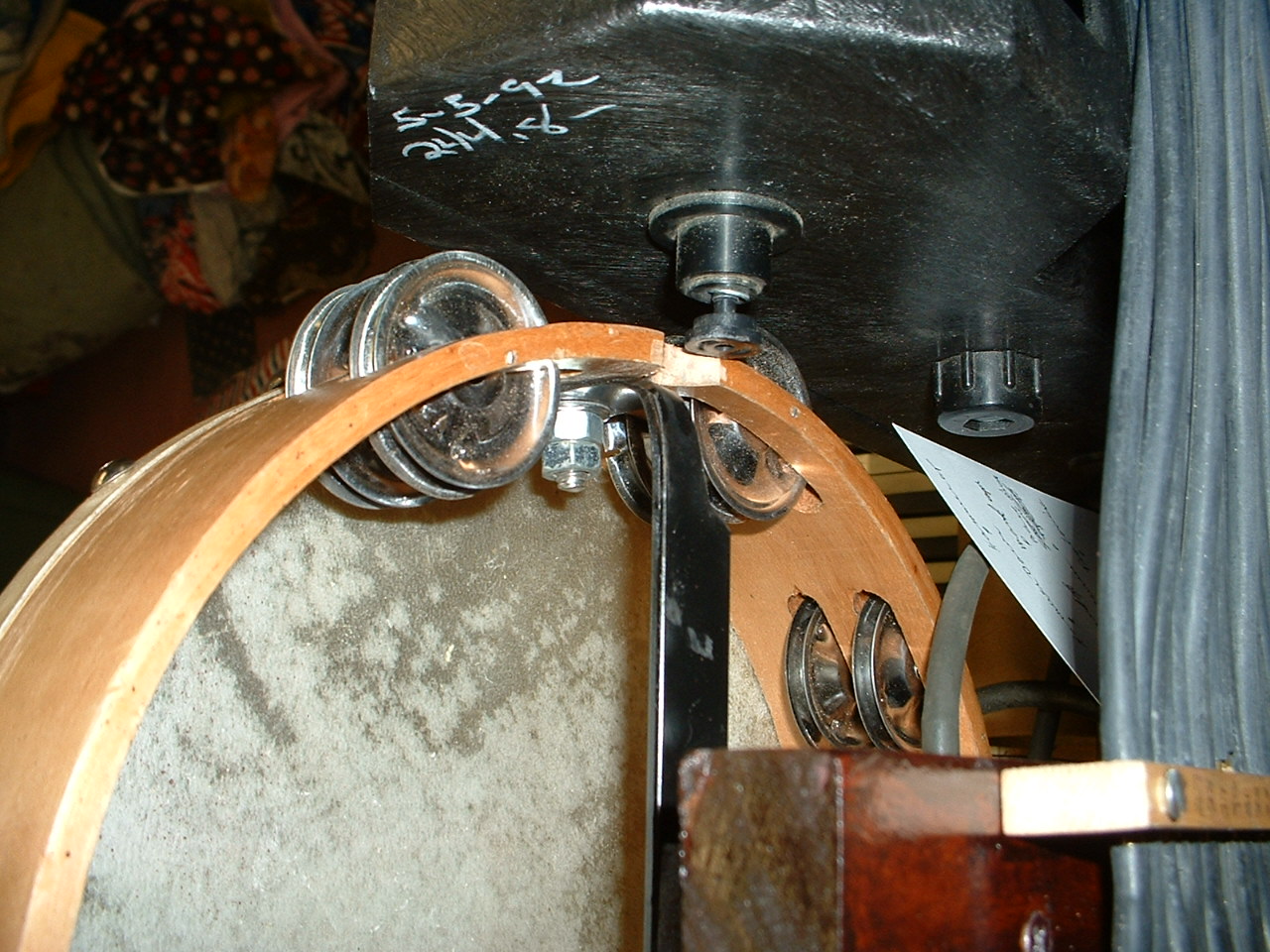
Then I found that we have an interference between the moveable mount and the spring loaded plunger will not retract far enough to put the test roll into the roll drive.


I took the tambourine off, ground the necessary clearance and remounted it.   Now we are ready to try the test roll.

Wednesday, May 2, 2018


                                                 Making an Orchestrion                                  Part 6


                            The piano we chose for this project is a 1909 Weber.    We have the upper
                            section  placement worked out.   We think we have everything properly
                            arranged, so we tubed the parts.   This is what it looks like from the rear.   


                           We fully expect that when we put this back in the piano, there will have to be
                            a few adjustments made, but we are pretty sure this is basically correct.

Wednesday, February 28, 2018


                                                 MAKING AN ORCHESTRION    PART 5

The piano we chose for this project is a 1909 Weber.   We have the upper section placement worked out, now we have to get serious about the lower area.

The vacuum box is placed on the right side against the top.


The xylo valves go on the bottom front.   The soft pedal pneumatic goes on the left, tucked about as high as we can get it.   The next step will be routing the vacuum hoses and pipes to feed all the instruments.


Wednesday, February 14, 2018


                                                  Making an Orchestrion     Part 4


The piano we chose for this project is a 1909 Weber.   Having rebuilt the stack and getting it properly fitted in the case, the next issue is placing the other items and instruments.

We have placed all the pieces on the shelf and think this will work out, subject to finding that we have to readjust due to unforeseen problems in the future.


Based on the hope this will work, we have run the valves to the manifolds on the deck and have started tubing the tracker bar for this configuration.


We have not yet found a home for the triangle.

Wednesday, January 31, 2018


                                                          MAKING AN ORCHESTRION 
                                                                                PART 3


The piano we chose for this project is a 1909 Weber.   Having rebuilt the stack and having gotten it properly fitted in the case, the next issue is placing the other items and instruments.


We think this will be the way the top shelf will be arranged.   The wood block in the form of a pecking bird goes on the left.   The bass drum goes next, then the roll drive and last is the tambouring and snare drum combination.


The xylophone goes in the bottom and there is not much room left for anything else.   We have not yet found a home for the triangle.

Wednesday, January 24, 2018


                                                    MAKING AN ORCHESTRION
                                                                      PART 2


The piano we chose for this project is a 1909 Weber.   Having rebuilt the stack and having gotten it properly fitted in the case, the next issue is replacing the other items and instruments.


The roll drive has to go on the top of the stack, but how we place the other items is more flexible.   We have a tambourine, triangle, a wood block in the form of a bird, bass drum, soft pedal pneumatic and mandolin rails & its pneumatic.    The xylophone fills the bottom of the case, so not much room is left there.


It will take some time to sort this all out.

Wednesday, January 17, 2018


                                                         MAKING AN ORCHESTRION
                                                                             PART 1

We have a few player pianos that have not been restored and decided to make an orchestrion out of one of them.    First we removed the player parts and fixed whatever problems existed with the piano action.


The next step was to rebuild the stack, eliminating the pneumatics not needed for the 66 playing notes  to be controlled by the O Roll we had decided to use and substituting connections for additional functions.

We obtained a Ragtime roll drive and now we are ready to start assembly.

Wednesday, July 12, 2017

FACT SHEET FOR CREMONA J


What Is It?

The Cremona Model J orchestral style was built in Chicago, by the Marquette Piano Company, about 1915.   This was the largest orchestrion built by Marquette.

How Rare Is it?

There were fewer than 20 made.   How many survive is unknown.

How Does It Work?

The music is contained on a paper roll with holes punched in it, designated as style M, which normally contains 10 songs.   The punched holes are "read" by a vacuum control system, that in turn opens valves, allowing the compressed air  to enter the selected pipes and play music.   The vacuum and compressed air are supplied by wood and leather bellows pumps driven by a crankshaft, which is turned by the electric motor in the bottom of the instrument.

The M Roll controls the piano, mandolin rail, bass drum, snare drum, flute pipes, violin pipes, triangle, tympani and xylophone.

What  Is It Worth?   What Did It Cost?

In 2004, one sold for $37,000 on eBay.   The 1915 selling price is unknown, but it was probably in the $1800 range.


Where Has It Been?

Its original location was at the Salt Air Amusement Park in Salt Lake City, UT.   It was then owned by someone in Casper, Wyoming.   Jake bought it from the third owner, George Schubert, in Gering, Nebraska for $4000.

Background Information


The Marquette Piano Co. started in Chicago, building piano actions but about 1915, expanded to building complete instruments, thus becoming one of the first American firms in this industry.   Until 1907, J.P. Seeburg worked for them until founding his own company.

Sold under the Cremona name, their major production was between 1905 and 1920.   They built high quality machines with interior parts highly finished, even though not visible.

Our Stewardship

Jake wanted instruments to play and was not hesitate to bypass "unnecessary" features to that end.   There was a booster pump added; but many of the "unnecessary" features such as treble soft, piano volume and xylophone were bypassed.   We have rebuilt the piano stack, reconnected the original pump and activated the other bypassed features.   After three attempts to get the xylophone playing, we have been only partially successful in this regard.


Wednesday, June 21, 2017

NELSON-WIGGEN STYLE 4X


This is a Nelson-Wiggen style 4X orchestrion.   It could be set up to play either the 4X or G paper roll.  It differs from many contemporary designs using a single stroke marimba rather than a reiterating one.   The Nelson Wiggen machines were some of the most complex vacuum operated machines of the era and some of their critics said if there was a simple way to do something they would not even consider doing it that way.

This was one of the more popular instruments produced by Nelson-Wiggen, but how many have survived is unknown.

The music is contained on a paper roll with holes punched in it, which normally contains 10 songs.   The punched holes are "read" by a vacuum control system, that in turn opens valves allowing the compressed air to enter the selected pipes and play the music.   The vacuum and compressed air are suppled by wood and leather bellows pumps driven by a crankshaft, which is turned by the electric motor mounted in the bottom of the instrument.

Our machine plays a ten tune 4X roll, which controls a Piano, Mandolin Rail, Trap Drum, Marimba & Triangle.

Built about 1925, its location is unknown until it was owned by Jake, who got it in parts someplace in New York State and reassembled it.   It played for several years after it came to us, but got weaker as time went on.   We did some patch work to keep it playing, but by 2012 it needed serious work, so we did a fairly complete repair, including case refinishing.   In the process, we found Jake had bypassed several control function, which we restored to the original condition.

Background information:

Oscar Nelson and Peder Wiggen, worked as engineers and factory supervisors for the J.P. Seeburg Company, until striking out on their own and forming the Nelson Wiggen Co. in Chicago in 1922.

Wednesday, April 5, 2017

A Collections Success Story- The Cremona G

Our Cremona G is serial number 11622; the piano action carries number 7500.


We have no information about the early life of this machine, but when Jake DeBence got it, the pipes, the air chest and the piano air chest were all missing.   The electric motor was missing.   The muffler rail was gone.  The good things were that the stained glass front was intact, the pump and roll drive were intact and the mandolin rail was still in place.  The modulating unit and the pressure reservoirs were also there.

Elizabeth started a search for a piano air chest and about 1970 Don Janisch provided a Cremona piano air chest from a model 10 or 20, which Jake adapted for this model G.   The air chest had more keys and more auxiliary valves than needed, so several functions were blocked off and not used in this application.   The modulating unit was bypassed.

A standard appliance motor (alleged to have been from a washing machine) was substituted for the missing motor and Jake had it playing.

When the museum obtained it with the rest of the collection in 1993, it was displayed and played as part of the main floor tours, until January of 2014, when it was moved to the second floor shop for work.   After posting questions on MMD, we gathered a lot of necessary information from many people about details of the work needed.   In June of 2014, The Laura Smedley Trust, administered by PNC, awarded a grant to pay for having a new set of pipes and the air chest made and we continued on the other work needed to bring it back to near original condition.

A new muffler rail was made.   The mandolin rail was repaired.   A correct motor was mounted and the pumps were rebuilt.   The piano air chest was reworked to provide attachment points for the pipe
pneumatics.   The modulating unit was rebuilt and put back on line.   The piano air chest tracker bar tubing connections were moved from the top to the bottom, out of the path of the new pipe connections for the pipe air chest pneumatics, so the fall board could be closed.   (When Jake adapted the piano stack, he just ran the hosed in front of and then over the top of the stack, which prevented the fall board from closing.)   The piano air chest valves were all checked and reset to proper clearance.   The piano action was repaired as needed.   In January 2015, Bruce Newman of Gold Beach, OR shipped us the new violin pipes and the air chest.   Installing them around a bigger than usual piano air chest was challenging, but accomplished. 

In late March of 2015, everything was working and the machine was placed on our main floor to again become part of the tour.   It sounds great.   A complete article with photos was in the MBSI Journal for Sept/Oct of 2015.

Tuesday, February 7, 2017

The Berry-Wood A.O.W. Orchestrion

Established in Kansas City, Missouri in 1907, the Berry Wood Piano Player Company was an early entry into the coin-operated piano field. They built very rugged, yet extravagant pianos, instruments and orchestrions. The Berry-Wood A.O.W. Orchestrion combined a piano with 34 wood flute pipes, 34 wood violin pipes, a tambourine, a triangle, a cymbal, a wood block, castanets, a bass drum, a snare drum, a marimba, metal bells and a mandolin rail all in one! This player piano operated via a paper roll and featured three stained glass panels and two decorative lamps. Because the A.O.W. Orchestrion plays 10 instruments it was perfect for use in "motion picture houses."
Even so, the company went out of business in 1920. Shortly thereafter demand for coin operated pianos increased dramatically as they became widely popular in public facilities, bars, and dance clubs or the era.
Today there is only one functional Berry-Wood A.O.W. Orchestrion (pictured here) in existence and it resides at DeBence Antique Music World in Franklin.